
Tesla’s Flying Roadster Runs on Compressed Air. We Have Questions.
Published by Filter Element Store on Oct 19, 2026
Compressed air has spent decades doing useful work without getting much attention. Running tools. Operating valves. Keeping production moving.
Now Tesla is using it to help launch a sports car through the air.
Apparently, tightening bolts was no longer challenging enough.
Wait—Tesla Has a Flying Car?
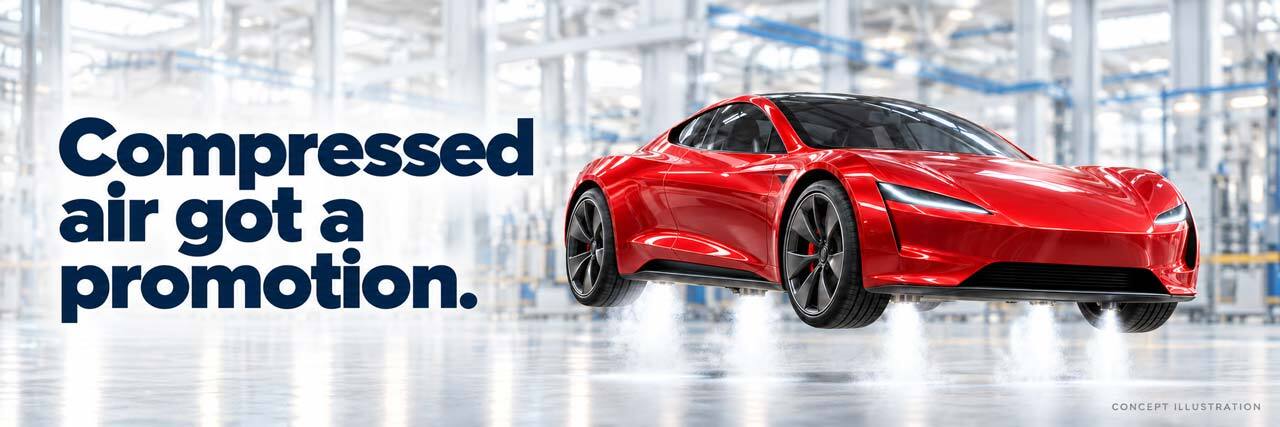
At its October 15, 2026 Roadster unveiling, Tesla demonstrated a vehicle performing an airborne stunt with help from compressed-air thrusters developed in collaboration with SpaceX.
The demonstration put the Roadster firmly in “did you just see that?” territory. But an airborne maneuver is different from sustained flight. We are not quite at the point of flying over interstate traffic on the way to work.
For now, you should probably keep your usual exit in the navigation system.
How Does Compressed Air Move a Car?
The basic idea is straightforward: store air under high pressure, then release it through carefully directed nozzles. The escaping air produces thrust that pushes the vehicle in the opposite direction.
Think of letting go of an inflated balloon, then add sophisticated engineering, precise controls, and a budget that would make your purchasing department sit down.
The compressed-air thrusters supplement an electric vehicle. This does not mean the Roadster’s normal driving range comes from a tank of air, or that its thrusters burn conventional rocket fuel.
There is also a limit to the air available. As stored air is discharged, that supply is depleted. Compressing it again takes energy. Compressed air can deliver a powerful burst, but it does not come with unlimited refills courtesy of physics.
Our Favorite Part? People Are Talking About Compressed Air.
In most facilities, compressed air only becomes a conversation topic when something stops working.
A cylinder gets sluggish. A tool loses power. Water shows up where it should not. Someone turns up the pressure and hopes the problem develops other interests.
Tesla’s demonstration is a dramatic reminder that compressed air is a way to store and deliver energy. Your plant probably uses that energy for something less theatrical, but reliable air delivery still matters.
A production line does not need to leave the ground to become expensive when it stops moving.
Back on Earth, Air Quality Still Matters
Tesla’s specialized system has its own engineering requirements. For everyday industrial compressed-air systems, the familiar concerns remain particles, water, and oil.
- Particulate filters help capture solid contaminants such as dirt, rust, and pipe scale.
- Coalescing filters remove fine liquid aerosols, including oil and water droplets. They do not replace a dryer for removing water vapor.
- Compressed-air dryers reduce water vapor to meet the application’s required dew point.
- Condensate drains discharge collected liquid so it does not accumulate in the system.
The right combination depends on the equipment, operating conditions, and air quality required. Installing a finer filter everywhere is not automatically an improvement; filtration also introduces resistance to airflow.
The goal is suitable air quality with controlled pressure loss—not winning a contest for the most filter housings on one wall.
Your Air System Deserves a Little Attention, Too
You may not have a rocket-assisted Roadster in the maintenance budget, but you can give your compressed-air system a useful check:
- Check filter differential pressure under normal operating flow.
- Replace elements according to the manufacturer’s service guidance.
- Confirm that drains discharge properly and are not continuously leaking air.
- Check dryer performance against the application’s moisture requirements.
- Investigate pressure loss before simply increasing compressor pressure.
None of those jobs will get the same attention as a car flipping through the air. They can, however, help keep your equipment working... which tends to be popular with the people paying the bills.
Tesla Is Already on Our Customer List
This story comes with a fun connection: Tesla is a Filter Element Store customer. We have supplied air intake filters, coalescing filters, and air/oil separators, with orders typically going to a Kyle, Texas location.
We cannot tell you those filters helped make a Roadster fly. We can tell you that even a company building futuristic vehicles still needs the everyday parts that keep compressed-air equipment working.
We appreciate the business. We also appreciate that our shipping department has not been asked to arrange an airborne delivery.
Whether your facility builds electric vehicles or makes something that stays firmly on the ground, we can help identify replacement filter elements. Send us the housing model, existing part number, or photos and dimensions.
Tesla’s purchases from Filter Element Store do not imply endorsement or any involvement in the Roadster project. This article does not identify replacement parts for vehicle thruster systems.