
Compressor Oil Viscosity Guide | ISO 32 vs 46 vs 68
Published by Filter Element Store on May 30, 2026
Shop compressor oil for rotary screw and reciprocating air compressors, including ISO 32, ISO 46, and ISO 68 lubricants made in the USA for reliable performance, long service life, and OEM replacement applications.
Compressor oil is one of the most important maintenance items in any compressed air system. The right lubricant helps control heat, reduce wear, resist oxidation, and protect expensive compressor components over long operating hours. At Filter Element Store, we offer Made in the USA compressor oil formulated for industrial air compressor performance and trusted by customers looking for a dependable alternative to OEM-branded lubricants.
Quick Selection Guide
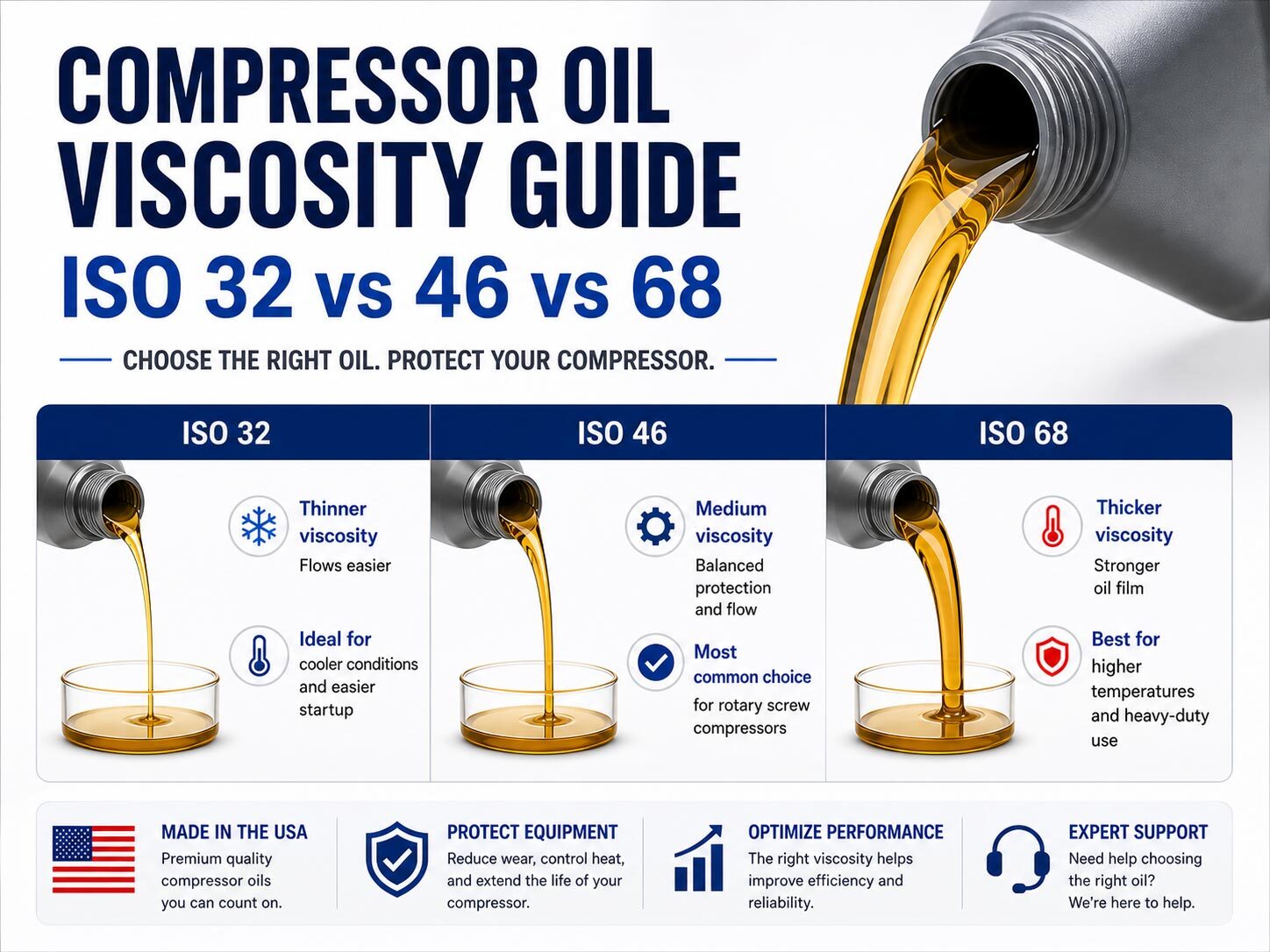
- Not sure where to start? ISO 46 is the most common viscosity grade for many rotary screw air compressors.
- Cold starts or cooler environments? ISO 32 may flow easier during startup.
- Higher temperatures or heavier-duty operation? ISO 68 may be required in some compressor applications.
Why Compressor Oil Matters
Compressor lubricant does much more than reduce friction. In oil-flooded rotary screw compressors especially, oil plays a direct role in cooling, sealing, and protecting the airend.
- Removes heat from the compression process
- Lubricates bearings, rotors, and moving parts
- Helps seal internal clearances in rotary screw compressors
- Reduces sludge, varnish, and carbon formation
- Supports longer service life and cleaner operation
What Does ISO 32, ISO 46, and ISO 68 Mean?
ISO viscosity grade refers to the thickness of the oil at a standard test temperature. The higher the ISO number, the thicker the oil. For compressor oil, this matters because viscosity affects startup flow, heat control, lubrication film strength, and how well the oil protects the compressor during operation.
| ISO Grade | Relative Thickness | Common Use |
|---|---|---|
| ISO 32 | Thinner | Cooler conditions, easier startup flow, lighter viscosity requirements |
| ISO 46 | Medium | Most common choice for many industrial rotary screw air compressors |
| ISO 68 | Thicker | Higher temperature, heavier-duty, or applications requiring thicker oil film |
Technical Performance Features
Industrial buyers often need more than a generic oil description. The technical details matter, especially when replacing an OEM compressor lubricant.
- High oxidation resistance for longer lubricant life
- Excellent thermal stability during continuous-duty operation
- Strong anti-wear protection for bearings and airend components
- Low volatility to help reduce oil carryover
- Good water separation characteristics
- Resistance to sludge, varnish, and deposit formation
Mineral vs. Synthetic Compressor Oil
Many customers ask whether they should stay with a mineral-based compressor oil or move to a synthetic compressor lubricant. The answer depends on the compressor design, operating conditions, maintenance goals, and OEM recommendations.
| Feature | Mineral Compressor Oil | Synthetic Compressor Oil |
|---|---|---|
| Typical Cost | Lower upfront cost | Higher upfront cost |
| Service Life | Shorter drain intervals | Longer service intervals in many applications |
| High Temperature Stability | Moderate | Typically better |
| Deposit Resistance | Good when maintained properly | Typically stronger resistance to sludge and varnish |
| Best Fit | Standard duty, cost-conscious applications | Extended run times, severe duty, higher temperatures |
Typical Compressor Oil Service Intervals
Drain intervals vary by compressor manufacturer, operating conditions, contamination levels, and lubricant type. The table below shows common industry guidelines.
| Oil Type | Typical Service Interval* |
|---|---|
| Mineral Compressor Oil | 2,000 - 4,000 Hours |
| Semi-Synthetic Compressor Oil | 4,000 - 6,000 Hours |
| Synthetic Compressor Oil | 6,000 - 8,000+ Hours |
*Always follow compressor manufacturer recommendations.
Is Synthetic Compressor Oil Worth It?
Synthetic compressor oil usually costs more upfront, but it may reduce total maintenance cost in the right application. For high run-hour compressors, severe-duty service, or hotter operating conditions, synthetic oil can often help reduce oil change frequency, labor time, downtime, and deposit-related problems.
For lower-hour or standard-duty compressors, mineral oil may still be a practical and cost-effective choice. The best answer depends on the compressor, operating environment, service interval, and OEM recommendation.
Pro Tip: If you are switching from mineral compressor oil to synthetic oil, check compatibility first and consider flushing the system. Mixing incompatible oils can shorten lubricant life and create sludge or varnish issues.
Made in the USA Compressor Oil
Our compressor lubricants are made in the USA by a trusted household-name manufacturer. That gives customers confidence in product consistency, quality control, and reliable sourcing. For many industrial buyers, it also provides a strong alternative to expensive OEM oil without sacrificing the technical performance they need.
Can You Switch from OEM Compressor Oil?
Many compressor owners want an alternative to expensive OEM lubricants such as Sullube®, Ultra Coolant, QuinSyn®, AEON™, and other manufacturer-branded compressor oils.
In many applications, compressor lubricants with compatible base stocks, additive packages, and viscosity grades can be used as a direct replacement without requiring a complete system flush. Our compressor oils are commonly used as pour-over compatible replacements in rotary screw compressor applications when lubricant compatibility requirements are met.
Always verify lubricant compatibility before mixing oils or changing lubricant types. If you are unsure, contact us with your compressor model and current lubricant information for assistance.
Common OEM Compressor Oil References
| OEM Lubricant | Typical ISO Grade |
|---|---|
| Sullair Sullube | ISO 32 |
| Gardner Denver AEON 9000 | ISO 46 |
| Ingersoll Rand Ultra Coolant | ISO 46 |
| Quincy QuinSyn Plus | ISO 46 |
| Gardner Denver AEON 4000 | ISO 68 |
| Quincy QuinSyn F | ISO 68 |
| Sullair AWF | ISO 68 |
OEM Compressor Oil Cross Reference
Many buyers search by OEM oil name, compressor brand, or existing lubricant reference. This category supports many common replacement applications across major compressor manufacturers.
Many OEM compressor oils are private-labeled and priced at a premium. In many applications, matching the correct ISO viscosity grade, base oil type, and compressor requirements is what matters most. When in doubt, send us the OEM oil name, compressor model, or part number and we can help point you in the right direction.
| Compressor Brand | Common Search Intent | Typical Oil Need | View Related Products |
|---|---|---|---|
| Sullair | Sullair compressor oil replacement | Sullube 32, Sullair AWF, Sullair SRF 1 and 2, Sullair 24KT | Sullair Oil Options |
| Ingersoll Rand | Ingersoll Rand compressor lubricant replacement | Ultra Coolant, Ultra SSR, Ultra FG, All Weather Season Select, T30, Pro-Tec, Techtrol Gold | Ingersoll Rand Oil Options |
| Atlas Copco | Atlas Copco oil cross reference | Roto Xtend, Roto Inject, Roto Inject Ndurance, Paroil M, Pairoil S, Roto Z, Roto-FG | Atlas Copco Oil Options |
| Gardner Denver | Gardner Denver compressor oil replacement | Aeon 800, 2000, 4000, 9000 SP, 9000TH, Aeon CL, Aeon PG, Aeon Bio, PD Blower Oil | Gardner Denver Oil Options |
| Quincy | Quincy compressor oil replacement | QuinSyn, QuinSyn PF, QuinSyn Edge, QuinSyn Flex, QuinSyn XP, QuinSyn Plus | Quincy Oil Options |
Common Applications
- Oil-injected rotary screw air compressors
- Reciprocating air compressors
- Industrial compressed air systems
- Maintenance department replacement programs
- OEM compressor lubricant cross reference applications
How to Choose the Right Compressor Oil
Before purchasing compressor oil, it is important to confirm the core technical requirements of the system:
- Compressor manufacturer and model
- Required ISO viscosity grade
- Mineral, semi-synthetic, or full synthetic requirement
- Recommended drain interval
- Operating temperature and duty cycle
- Any OEM specification or known cross reference
Oil problems can also show up as excessive oil carryover, dirty downstream filters, or a failing air/oil separator. If your compressor is passing oil downstream, the lubricant may not be the only part to check. You may also need to inspect the air/oil separator, oil filter, scavenge line, or related maintenance parts.
Why Buy Compressor Oil from Filter Element Store?
- Made in the USA compressor lubricants
- Strong technical fit for industrial air compressor applications
- Alternative to higher-priced OEM compressor oil
- Support for viscosity and application matching
- Fast shipping on compressor maintenance products
Need Help Matching Compressor Oil?
Send us your compressor model, OEM oil name, part number, or current viscosity grade and we can help narrow down the right replacement option.
Contact Us for HelpWhether you need ISO 32 compressor oil, ISO 46 compressor oil, or ISO 68 compressor oil, this viscosity guide is built to help you find the right lubricant for your compressor and cross reference needs.