
Hydraulic Filter Types Explained: Pressure vs Return vs Suction Filters
Published by Filter Element Store on Apr 30, 2026
Not all hydraulic filters do the same job, and choosing the wrong type can shorten equipment life fast.

If you’ve ever tried to match a hydraulic filter and got stuck between pressure filters, return filters, or suction strainers, you’re not alone. These terms get used interchangeably, but they serve very different roles in a hydraulic system. Understanding where a filter sits in the system is just as important as micron rating or size.
This guide breaks down the main types of hydraulic filters and where they actually belong.
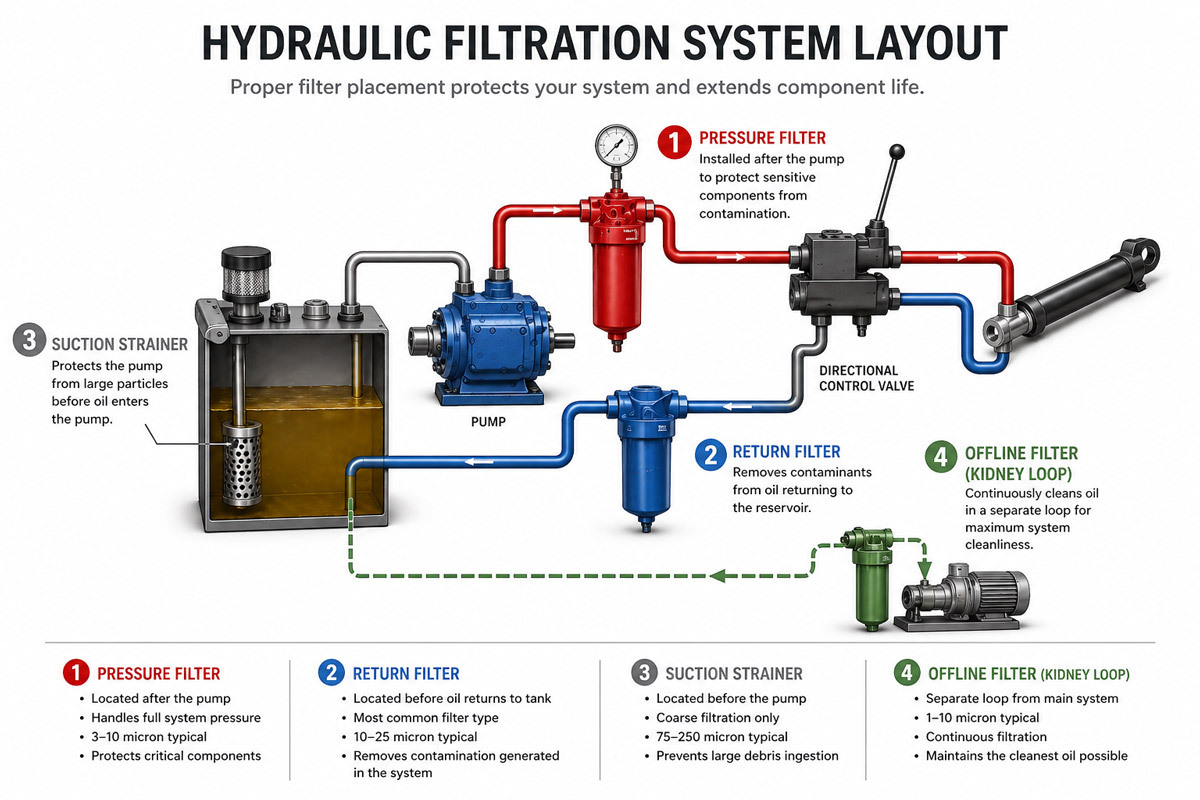
Quick Comparison of Hydraulic Filter Types
| Filter Type | Location | Typical Micron | Purpose |
|---|---|---|---|
| Pressure Filter | After pump | 3–10 micron | Protect critical components |
| Return Filter | Before tank | 10–25 micron | Clean oil returning to reservoir |
| Suction Strainer | Before pump | 75–250 micron | Prevent large debris ingestion |
| Offline Filter | Separate loop | 1–10 micron | Continuous fine filtration |
Pressure Filters (High-Pressure Protection)
Pressure filters are installed directly after the hydraulic pump and are designed to handle full system pressure. This is where filtration matters most because any contamination here goes straight to valves, actuators, and other precision components.
These filters typically use high-efficiency media in the 3 to 10 micron range and are built with reinforced elements to handle pressure spikes.
Best for: Servo valves, proportional valves, and high-performance systems.
Return Line Filters (Most Common Setup)
Return filters sit on the line returning oil to the reservoir. Instead of protecting components directly, they clean the oil before it cycles back through the system again.
This is the most common filtration setup because it’s cost-effective and captures contamination generated during operation.
Best for: General hydraulic systems and mobile equipment.
Suction Strainers (Basic Protection Only)
Suction strainers are installed before the pump and are meant to stop large debris from entering. They are not fine filters and typically range from 75 to 250 micron.
Overly fine suction filtration can actually cause more harm than good by restricting flow and leading to pump cavitation.
Best for: Backup protection only, not primary filtration.
Offline (Kidney Loop) Filtration
Offline filtration systems operate independently of the main hydraulic circuit. They continuously pull fluid from the reservoir, filter it, and return it clean.
These systems are often used in critical or high-value equipment where maintaining low contamination levels is essential.
Best for: Industrial systems, large reservoirs, and uptime-critical applications.
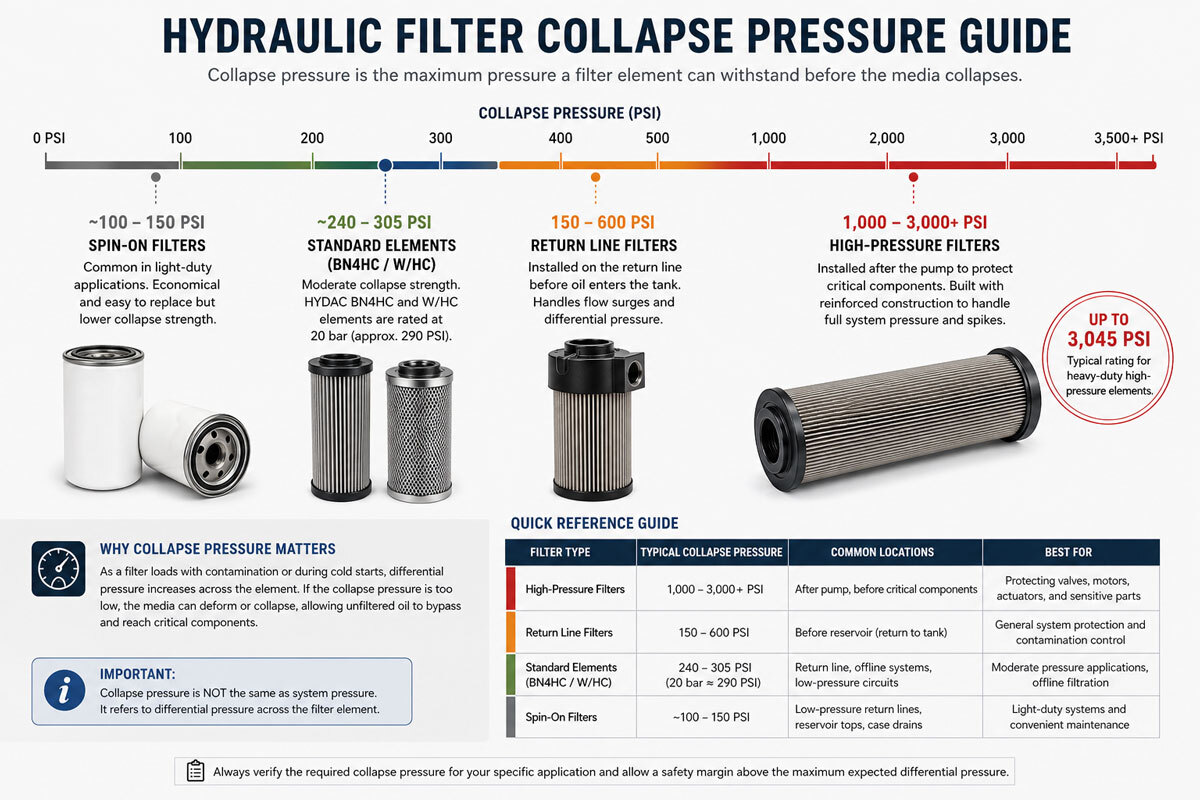
Typical Hydraulic Filter Collapse Pressure Ratings
| Filter Type | Typical Collapse Pressure | Where Used | Notes |
|---|---|---|---|
| High-Pressure Filter | 1,000 – 3,000+ PSI | After pump | Protects critical components, heavy-duty construction |
| Return Line Filter | 150 – 600 PSI | Before tank | Handles flow surges and differential pressure |
| Spin-On Filter | ~100 – 150 PSI | Light-duty systems | Cost-effective but more prone to collapse |
| Standard Elements (BN4HC / Wire Mesh) | ~240 – 305 PSI | Return / offline | Moderate strength, not for high-pressure circuits |
Which Hydraulic Filter Type Should You Use?
Most systems don’t rely on just one type. A typical setup might include a return filter for general cleaning and a pressure filter for component protection.
If you’re trying to improve system cleanliness or extend component life, adding an offline filtration loop is often the biggest upgrade you can make.
Send us your part number, dimensions, or a photo of your existing element and we’ll help you find the correct replacement.
We specialize in aftermarket hydraulic filter elements, including high-pressure and return line configurations.